
Physical Therapy Website Management
4 Tips For Avoiding The Most Costly Location Page Errors
The most expensive website management error for multi-location physical therapy clinics isn’t a design issue—it’s misreading local SEO performance. A common scenario: website visits, engagement, and form fills are rising, but leadership concludes “local SEO isn’t working” because Google Business Profile (GBP) numbers look flat or unpredictable.
To manage local SEO well, you need two things:
- Clarity on what GBP KPIs actually mean (and what they don’t).
- A tight relationship between each location’s GBP and its matching website location page so local signals reinforce each other.
This article breaks down the core GBP KPIs, what to expect as your website’s local signals get stronger, and the biggest reporting mistakes that make good progress look like failure.

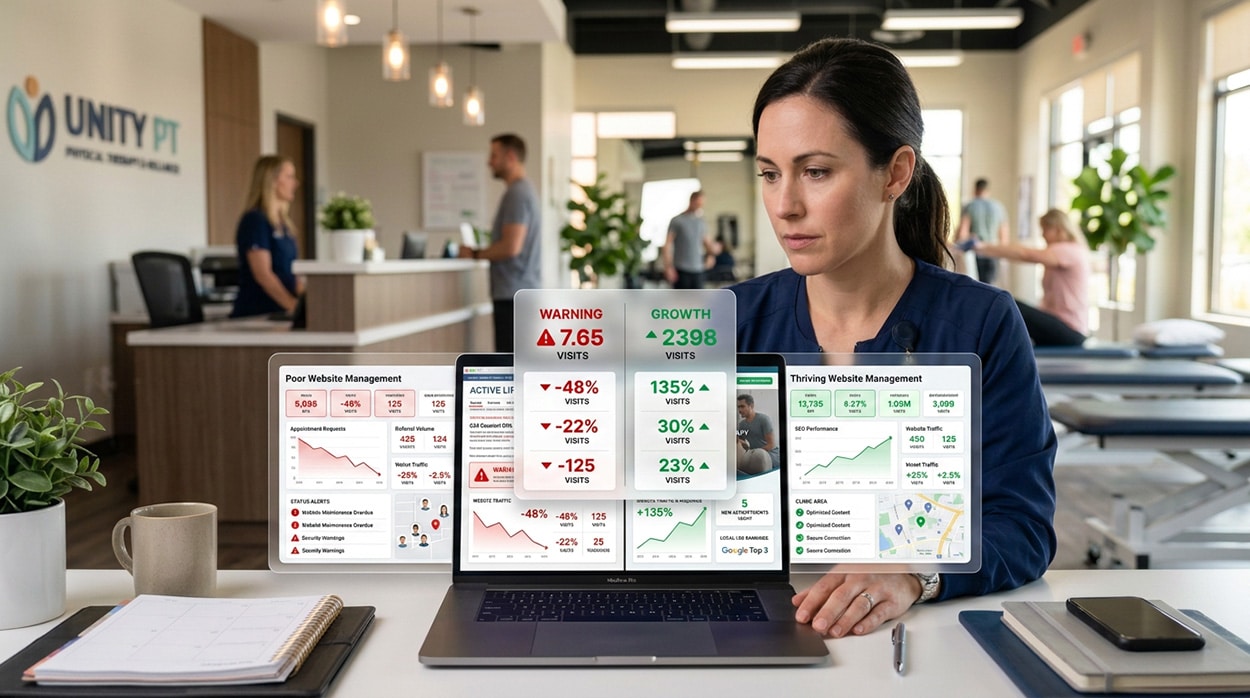
Tracking website traffic, search rankings, and patient engagement metrics helps identify problems early and measure the impact of ongoing website management efforts.
First, the relationship: GBP per location + the matching website location page
For a physical therapy business manager, it helps to think of local SEO like a “two-engine plane”:
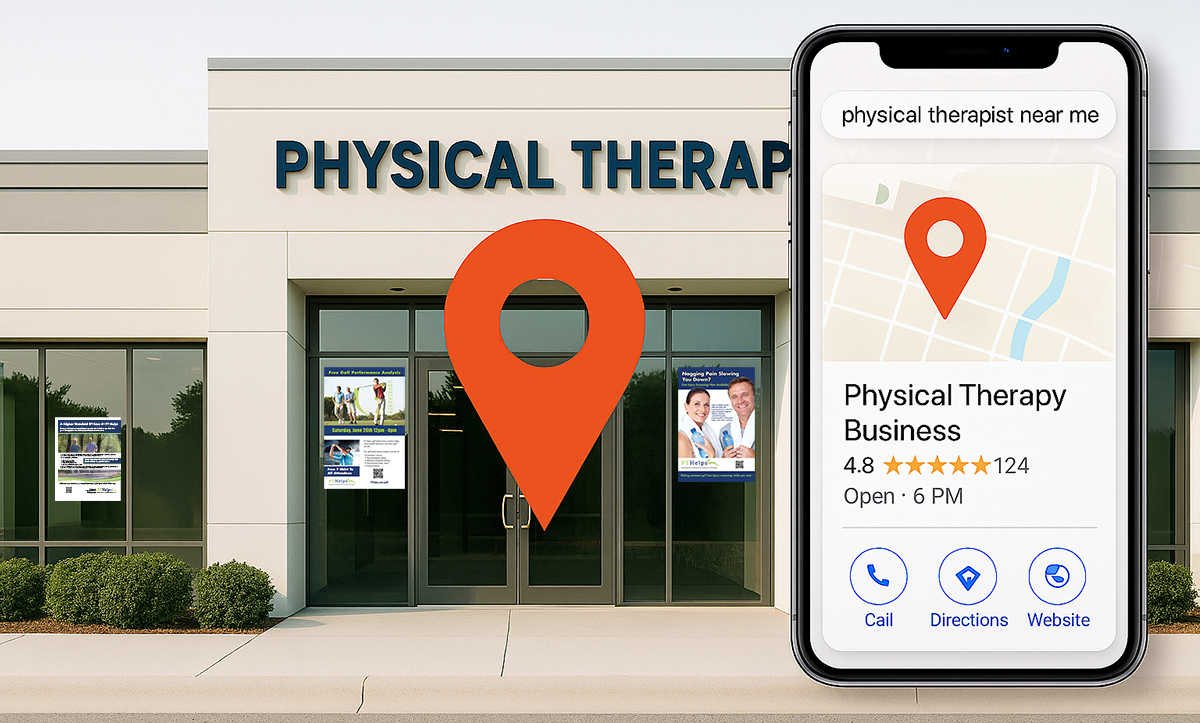
- GBP (one per clinic location) is your strongest asset for showing in the map pack and Google Maps. It’s an entity listing with its own performance metrics (views, clicks, calls, etc.).
- Your website location page (one per clinic location) is your strongest asset for proving relevance, trust, and service clarity—plus it’s where you convert visitors into booked evaluations.
Google connects these two. When the location page becomes more locally relevant and trustworthy, it can improve your ability to:
- Rank the location page organically for “physical therapy near me” and service + city queries
- Support stronger map visibility for the matching GBP
- Turn more GBP traffic into actual bookings (because the landing experience is better)
The key management rule: each GBP should link to its own location page, not the homepage and not a generic “Locations” directory page.
What counts as “website local signals” for a PT clinic?
When people say “local SEO on the website,” they typically mean signals that help Google (and patients) confidently match a specific clinic location to a specific service need. Common website local signals include:
- Strong, unique location pages with accurate name/address/phone (NAP), hours, directions/parking, service availability, and clear calls-to-action
- Clear service-to-location connections (which services are offered at which clinic)
- Local business schema (structured data) that reflects each clinic location
- Internal linking that makes it easy for Google to understand the location hierarchy (Homepage → Locations → Individual location page → related services)
- Consistent NAP across your site and key listings (no mismatched suites, old phone numbers, or duplicate locations)
- Authority signals (local citations, local links, brand mentions, and a trustworthy clinic brand footprint)
The GBP KPI scoreboard: what Google reports, what it means, and what you should expect
GBP Performance reporting can change over time, but the core categories are consistent. Below are the KPIs most physical therapy managers see and how to interpret them.
1) Views (Maps + Search)
What it is: How many times your GBP listing was shown to searchers—either in Google Maps or in Google Search local results.
What it means: Your visibility. This is a top-of-funnel metric. Views can rise or fall for reasons that have nothing to do with your website (seasonality, competitor moves, Google layout changes, tracking changes, etc.).
What to expect as website local signals get stronger:
- In many markets, you’ll see gradual increases in views as rankings improve and Google trusts the location’s relevance.
- Sometimes views don’t change much, but interactions (calls, website clicks, directions) improve—meaning you’re being shown to better-fit searchers.
2) Searches / Queries (how people found you)
What it is: The searches that triggered your listing (often shown as query themes and counts).
What it means: Whether you’re appearing for branded demand (your clinic name) versus non-branded demand (service + city, “near me,” condition-based searches).
What to expect as website local signals get stronger:
- Non-branded discovery should improve over time if your location pages clarify services and local relevance.
- If you publish stronger service + location content, you may see your listing showing for more specific rehab terms (e.g., “sports physical therapy,” “post-op knee rehab,” “vestibular therapy”).
3) Website clicks (from GBP to your website)
What it is: Clicks on the “Website” button from your GBP.
What it means: Your GBP is generating visitors who want more information (insurance, services, booking, directions, clinicians).
What to expect as website local signals get stronger:
- If each GBP links to the correct location page, you often see higher website clicks and higher conversion rates because the landing page matches the searcher’s intent.
- If your website improves organic rankings, some patients will go directly to the website (without clicking GBP). In that case, GBP website clicks may not rise as much as total organic sessions—and that’s not a problem.
4) Calls (tap-to-call from GBP)
What it is: Calls initiated by tapping the call button on your GBP listing (often reported by day of week/hour).
What it means: High-intent demand. In PT, calls typically represent patients ready to verify insurance, availability, or schedule.
What to expect as website local signals get stronger:
- As you gain map visibility, calls often trend upward—especially if your reviews, categories, services, and photos support trust.
- Calls can also shift to website-driven calls if your location pages get stronger and more visitors arrive through organic search (meaning calls may increase overall, even if GBP-call growth looks modest).
5) Direction requests (or “Get directions” actions)
What it is: Taps on “Directions” from your GBP listing.
What it means: Strong intent for in-person services. For physical therapy locations, this is one of the cleanest “almost-a-patient” signals.
What to expect as website local signals get stronger:
- When local relevance and trust improve, directions often rise—especially for non-branded searches.
- For multi-location clinics, better location pages can reduce confusion and improve the “right location” choice, which can improve direction requests for the correct clinic.
6) Messages / bookings (if enabled)
What it is: Leads generated through GBP messaging or booking integrations (availability depends on your setup).
What it means: Direct lead volume from GBP.
What to expect as website local signals get stronger: If you pair stronger local pages with frictionless booking, these can rise—but only if response times and processes are solid. (A slow reply can reduce future volume.)
7) Reviews (count, rating, velocity, and content)
What it is: Your quantity and quality of Google reviews, plus how frequently new reviews arrive.
What it means: A core trust and conversion driver. Reviews influence both click-through behavior and local competitiveness.
What to expect as website local signals get stronger: Reviews don’t automatically increase because of SEO, but improved visibility and patient volume often lead to more review opportunities. Track reviews per location as an operational KPI, not just a marketing metric.
The most important KPI shift to watch: “Visibility” → “Qualified actions”
This is where many teams get tripped up. A successful local SEO strategy often shows up first as:
- More website sessions to location pages
- Longer time on site / higher engagement
- More contact form submissions, online requests, and tracked calls
Meanwhile, GBP metrics may move slower, or appear noisy. That doesn’t mean local SEO isn’t working—it may mean your website is capturing demand that previously never made it to your GBP.
Tip #1: Put each GBP on the correct location page (and make that page conversion-ready)
If your GBP links to the homepage, you force a high-intent local searcher to do extra work. For multi-location physical therapy clinics, that usually lowers conversion and makes attribution messier.
What to do:
- Link each GBP website URL to its matching location page
- Add clear CTAs: “Request an Appointment,” “Call This Location,” “Get Directions”
- Put the NAP and hours above the fold (especially on mobile)
- List services offered at that location (not generic network-wide claims)
KPI impact you should expect: better website conversion rate from GBP traffic, more direction requests, and improved “right-location” engagement.
Tip #2: Build a KPI report that separates GBP actions from website outcomes
To avoid the “local SEO isn’t working” false conclusion, separate these two buckets in reporting:
- GBP KPIs (per location): views, searches/queries, calls, website clicks, directions, messages/bookings, reviews
- Website local KPIs (per location page): organic sessions, engaged sessions, scroll depth/time on page, call clicks, form submissions, online scheduling completions
Then add one more layer: lead quality (scheduled evaluations, referral starts, or whatever your clinic uses as the “real conversion”).
KPI impact you should expect: fewer misleading “flat GBP” narratives because you can show that website local signals are increasing conversions even before GBP visibility fully catches up.
Tip #3: Expect a sequence—leading indicators move before lagging indicators
When website local signals get stronger, you often see improvements in this order:
- Leading indicators: location-page impressions and clicks in Search, organic sessions, engagement, conversions on the site
- Mid-funnel indicators: GBP website clicks, calls, and direction requests (more consistent growth)
- Lagging indicators: sustained map pack rankings for competitive terms, review velocity (as patient volume increases), and stable share of local visibility
What this means for managers: it’s completely possible for “site visits and engagement” to rise first, while GBP views look unchanged for a while. If conversions are rising, the system is working—you’re just earlier in the visibility curve for maps.
Tip #4: Strengthen the website signals that most directly influence GBP performance
GBP optimization matters, but if your goal is to shift GBP KPIs through website work, focus on the website elements that reinforce the location entity:
- One strong location page per clinic (no duplicate copy-paste pages)
- Consistent NAP (site-wide and across major listings)
- LocalBusiness/MedicalBusiness schema reflecting each clinic
- Service content tied to the location (what’s offered where)
- Internal links pointing to the location page from relevant services and blog content
- Local citations and links that mention the location and point to the correct URL
KPI impact you should expect: improved relevance and trust, which tends to increase non-branded discovery, direction requests, and calls over time.
What “success” looks like (so you don’t misjudge it)
If your clinic is executing local SEO correctly, you should expect a mix of outcomes—not one magic number.
- Website: more organic sessions to location pages, more conversions, better conversion rate from local traffic
- GBP: gradual growth in calls/directions/website clicks (often more meaningful than views)
- Business outcomes: more scheduled evaluations and higher-quality leads at each location
The key takeaway: GBP KPIs and website KPIs move together—but not always at the same speed. When your website local signals get stronger, you often see higher engagement and conversions first. Over time, that same clarity and trust can support stronger GBP performance—especially in non-branded discovery and high-intent actions like calls and directions.